The Doyles of Lanark County
and the generations that followed
Probably the most difficult aspect of writing a narrative such as this is simply deciding where to begin. My search for ancestral clues began as an exciting adventure in 1986 and has been eagerly pursued over the years. The detail and documentation became an absorbing hobby that consumed hundreds of hours otherwise wasted in sleep. But actually sitting down to join all the facts into a readable document was the hard part — so much so that the farther along in the project, the less certain one becomes that the objective has been reached.
Here is the story of our early ancestors in and from Ireland, and traces the years from their arrival in Canada to the present. We intend this chronicle to be a living document of our families, but without the things you know about your family, the story can never be completely told.
One of the real joys of this search has been discovering all the aunts, uncles, and cousins tucked away in that other life that was the past. Meeting and talking with people who were just memories, and hearing their tales, has brought the past into focus and helped me appreciate the joy of families. If any of that warmth reaches you through these pages, it results from the sharing of good times and bad by the Doyles we have met, talked with, or corresponded with across the distance.
In particular, my brother Vincent, without whom… as the saying goes. Providentially, just as I began searching for the limbs of our family tree, Vincent was spending much of his free time compiling data on the Doyles in our immediate family. He shared material that appears in this book, saving countless hours, and we continued collaborating on the search until his death.
Mourn the Cowed and the Meek
Who see the World’s Great Wrongs
But Dare not Speak. — Anon.
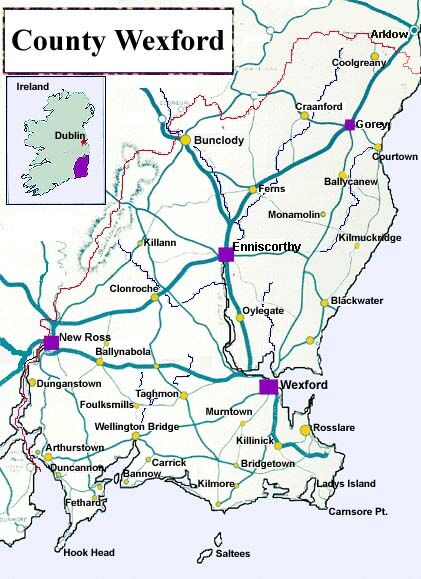
County Wexford, Ireland — the ancestral homeland. The towns of Gorey and Enniscorthy, named in the earliest records of the Lanark County Doyles, are clearly visible in the county’s north and centre.
Evidence suggests the original Doyles of Lanark County came to Canada from County Wexford, Ireland, in and around Gorey and Enniscorthy. However, the reason for emigration to the Ottawa Valley specifically remains unknown. Whether the generation headed by Michael J. was the first of our immediate family to come to Canada is not yet firmly established. The single largest source for early detail on the Doyles of Carleton Place and Smiths Falls came from the 1891 Census.
Wexford began as a Viking settlement in the 9th century, when raids first occurred in 819 CE. The "deep pool" in or around today’s Crescent Quay provided safe berthing for longboats. The Vikings’ settlement was called Waesfjord — "the inlet of mudflats" — which evolved into the name Wexford. Following the Norman conquest in the late 12th century, a walled town was established. Over ensuing centuries, Wexford became a successful port, though during the 20th century, silting of Wexford Harbour made it almost unnavigable, now restricting it to pleasure craft and a small fishing fleet.
Over the years, Wexford has remained at the forefront of Irish history. Due to its position, it has been constantly targeted by invaders — the Vikings, the Normans, and most tragically, Oliver Cromwell, whose armies entered Wexford town in 1649, killing over half its inhabitants. Wexford was also an important site for the failed rebellion of 1798, and in its aftermath, the heads of many rebellion leaders were displayed on Wexford Bridge. This important event has been immortalized in songs such as "The Boys of Wexford" and "Boolavogue," which most Wexford people learn in primary school.
Following an economically depressed mid-twentieth century period, Wexford has recovered and is now a vibrant, forward-looking town. Its people are fiercely proud of where they come from, and the town exudes a certain joie de vivre that can be hard to find elsewhere in Ireland. Perhaps due to its maritime past, recurring waves of invaders, or its annual world-famous Opera Festival, Wexford is also one of the most cosmopolitan towns in Ireland. It is also one of the cleanest, having been declared "litter free" by a recent inspection from Irish Businesses Against Litter.
The name Doyle is the anglicized form of the Gaelic DubhGhaill, pronounced "Du-Gall," which contains the elements dubh, meaning "black" or "dark," and gall, meaning "stranger." In Scotland, the same Gaelic name produced the surname McDowell, which came to Ireland, and the Scots names Dougall and MacDougall, which are closer in pronunciation. The name appears as early as 978 A.D., and through the 16th century Doyles controlled most of the land in County Wexford and nearby County Carlow.
As DubhGhaill, the name appears in the Annals of the Four Masters at various times between 978 and 1013. It does not appear in works concerned with Irish genealogy, as the Doyles were thought to be descended from Norsemen. But if the original nameholders were dark and strange as their description suggests, then these invaders were either Celts or more likely Danes (who were darker than the Norsemen). The Irish Parliament of today is spelled Dáil but is pronounced "Doyle."
In the early 1800s, land grants were offered to United Kingdom settlers to come to Canada. This practice continued until the 1830s. A Terrance Doyle, one of seven bachelors who came over around 1822, was granted a "residence" by the Queen in 1823. The potato famine occurred in Ireland between 1845 and 1849, and in 1845 alone, 103,000 people sailed from Ireland to the U.S. and Canada. The journey took six to eight weeks, and hundreds died of cholera, dysentery, exposure, and malnutrition. While the famine is largely unconnected to our family’s migration, over the years sufficient numbers of Doyles were attracted to this country to give us a current population in Canada of over 13,000 (as of 2018), and almost 90,000 in the United States, who carry the name.
As a matter of interest, according to In Search Of Your Roots by Angus Baxter (Macmillan of Canada, 1978), the Easter Rising of 1916 and subsequent Irish Civil War in 1922 all but destroyed vital records of Ireland, especially those of Protestant families, when the Public Record Office in Dublin was set afire by opposing forces during the Battle of the Four Courts on June 30, 1922. Catholic records, which have always remained in the care of local parishes by church policy and were not involved, only go back about 200 years in cities and towns, and only about 150 years in rural areas.
Another fact to bear in mind as one reads through the records is the naming pattern of the 18th and 19th centuries in the British Isles:
- Son 1 Named after the father’s father
- Son 2 Named after the mother’s father
- Son 3 Named after the father
- Son 4 Named after the father’s eldest brother
- Daughter 1 Named after the mother’s mother
- Daughter 2 Named after the father’s mother
- Daughter 3 Named after the mother
- Daughter 4 Named after the mother’s eldest sister
Whether the generation headed by Michael James was the first of our immediate family to come to Canada is not yet firmly established. Much of the early detail on the Doyles of Carleton Place and Smiths Falls came from the 1891 Census. Census data is available through the National Archives, though it is Canada’s policy to hold specific census details private for up to 100 years.
While we know of several generations of our family in Canada, for purposes of this narrative, I have chosen to deal only with the Doyles of Lanark County; therefore, the generations shown begin with Michael J & Molly Sutton and their families.
The census does not show addresses but shows the sequence of houses and families visited. There is no distinction on the census form between Michael James’s house and that of Mary Doyle Sinnott, his sister, for instance. The 1891 census offers many other details about the Doyles in Carleton Place. For instance, it shows Michael James Doyle was born in the United States, not Ireland, as once believed.
The census form, in addition to gender, shows marital status, country of birth, father’s country of birth, occupation, language classification, religion, and whether respondents could read and write. Imagine trying to ask those questions today. In any event, it is significant that according to the census, all adult Doyles were able to read and write in 1891 — or they lied a lot.
Other censuses are available in decreasing detail and clarity, all the way back to 1821. Because data gathering procedures and the form the data took kept changing, it is sometimes very difficult to track a family from census to census, but there are invaluable clues in each census, all available at the National Archives in Ottawa.
It may also be necessary, in this enlightened age, to apologize to the women of the Doyle family without whom, obviously, there would be none of us, and who are, along with all women, generally subordinated in genealogy. While science has shown us that chromosomes determining our genealogical makeup are formed by genes of both parents, it was long held that male genes were the dominant bloodlines and that women were merely carriers of progeny. To a great extent, this belief was largely responsible for the mapping patterns of most genealogical charts — that of the male lines.
My own excuse is simply that I chose to map the "Doyles" of Lanark. Therefore, once a name change has been effected through marriage, descendants are not considered germane to this story, however flawed that thinking may be. It must be noted, however, that if one were doing a serious study related, for instance, to an inherited disease, it would be impossible to be conclusive unless the families of both parents were examined equally. You can also appreciate the substantial increase in the size of this project and the result if that approach had been undertaken.
I should also apologize at the outset for the inevitable errors in the narrative. Unlike a conventional story, where one worries about typographical errors, here we are more concerned with factual errors and omissions. Because the research involves sources that are not always reliable due to condition or clarity, and cross-checking is impossible in many areas, the margin for error is great.
People remember things in completely different ways based on their point of view. A favourite nephew will remember "kind" old Aunt Sarah, from whom he received presents, in a much more favourable light than his sister might, who perhaps used to receive the back of Aunt Sarah’s hand. So if there are errors, I not only beg you to understand how they could have occurred, but ask your help in correcting them.
Please, while you pore through the cosmos, take the time to write down any incorrect facts and email the correct information to us at doylefamily20@gmail.com.
A final note: In reading through the stories outlining our family, it will be noted that “’til death do us part” was not necessarily a Doyle long suit — the author included.